Official Announcement

Jon-Claude Jenkins Announces Candidacy for Mayor

DeWitt, Arkansas • January 2026
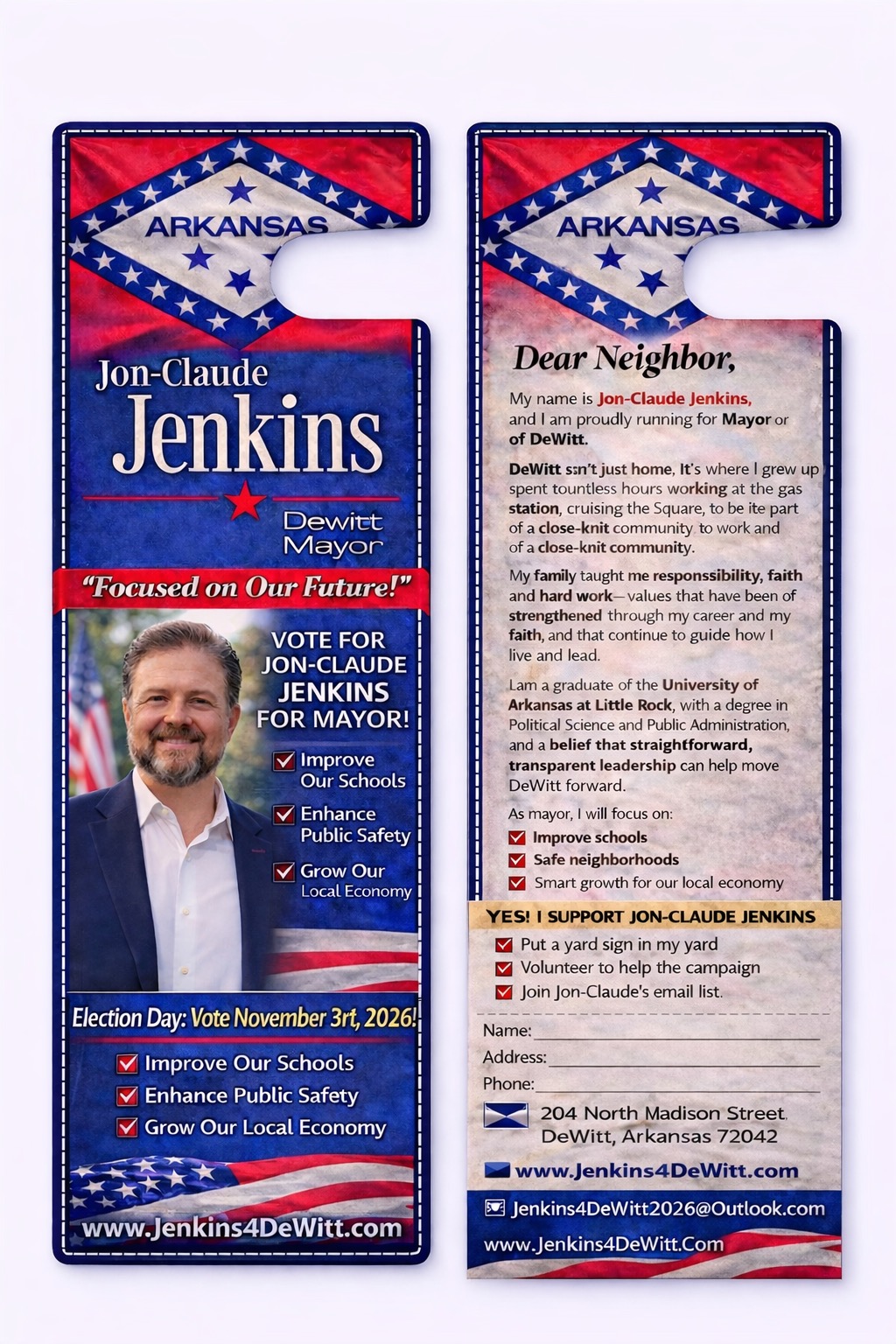
Jon-Claude Jenkins campaign door hanger featuring Arkansas flag, platform points including economic growth and infrastructure, and election information

My name is Jon-Claude Jenkins, and today I am proud to announce my candidacy for Mayor of DeWitt, Arkansas.

I was born here. I was raised here. My parents served this community with dedication and faith. My father was a judge who served Arkansas County for over 50 years, demonstrating daily the importance of justice and service to others. My mother instilled in me the principles of hard work, integrity, and dedication to family.

For more than 27 years, I have been engaged in business, working with people from all walks of life—locally and around the world. I have gained invaluable experience that has equipped me with the skills needed for effective leadership.

I'm also a proud father of two wonderful children. I want them—and every child in this community—to grow up in a town with opportunity, safety, and hope. I want DeWitt to be a place where families can build their futures, where businesses can thrive, and where neighbors look out for one another.

I believe DeWitt's best days are still ahead of us. I believe we can grow our local economy, continue improving our infrastructure, strengthen public safety, and expand youth programs that prepare the next generation of leaders.

But I also know that real progress doesn't come from one person—it comes from all of us working together. That's why I'm committed to listening to your ideas, your concerns, and your vision for DeWitt's future. This campaign isn't just about me. It's about us.

I ask for your support, your ideas, and your trust as we move DeWitt forward—together.

Thank you, and God bless DeWitt, Arkansas.

— Jon-Claude Jenkins

Jon-Claude Jenkins in professional business meeting with leadership team discussing economic development strategies

Community Initiative Details

III. Youth Engagement Programs

Building structured places for our youth to gather, compete, learn, and lead creates lasting loyalty and investment in our community.

The Challenge: Young people leave DeWitt not because they don't love it, but because they see no structured path to stay engaged, develop skills, or build their future here.

Our Approach: Create year-round programming that gives youth reasons to stay, skills to succeed, and pride in their hometown.

Phased Youth Activity Center Development

Strategic development of facilities where young people can gather safely and productively, building community bonds and civic pride.

Phase 1 Year 1: Foundation (Months 1-12)

  • Secure 5,000 sq ft facility through lease or donation
  • Install basketball court, gaming area, study spaces
  • Launch after-school program (3-6pm weekdays)
  • Target: 75 regular youth participants

Phase 2 Year 2: Expansion (Months 13-24)

  • Add computer lab with 15 workstations
  • Create maker space with 3D printer, tools
  • Weekend programming (Saturdays 10am-4pm)
  • Target: 150 regular participants

Phase 3 Year 3: Full Operation

  • Full-time director + 3 part-time coordinators
  • Summer day camp program (June-August)
  • Target: 250+ youth served annually

Success Metrics

250+
Youth Served
85%
Retention Rate
40+
Hours/Week
20+
Volunteers

Recreation Leagues and Tournaments

Organized sports and competitive events that bring families together and create opportunities for youth to develop teamwork and leadership skills.

Seasonal Sports Leagues

Spring: Youth Baseball/Softball Mar-May

4 age divisions (6-8, 9-11, 12-14, 15-17) • 8-week season • Championship tournament

Summer: Basketball & Swimming Jun-Aug

3-on-3 tournaments • Swim lessons & meets • Skills camps

Fall: Flag Football & Soccer Sep-Nov

Co-ed teams • Parent volunteer coaches • End-of-season celebration

Winter: Indoor Sports & E-Sports Dec-Feb

Basketball leagues • E-sports tournaments • Fitness challenges

Signature Annual Events

  • DeWitt Dragons Classic: Regional youth basketball tournament (March) - 32 teams, $500 scholarships
  • Summer Skills Showcase: Multi-sport competition (July) - Track, field events, team challenges
  • Harvest Games: Fall festival with sports, games, food (October) - Community-wide celebration

Expected Outcomes

Youth participants annually 400+
Volunteer coaches recruited 50+
Family attendance at events 1,500+
Regional visitors attracted 800+

Skills Workshops

Hands-on training in high-demand fields that prepare youth for career opportunities and economic self-sufficiency.

🔧 Welding & Fabrication Track

Program Structure:

  • • 12-week intensive course (Tuesdays/Thursdays 5-7pm)
  • • Partnership with Arkansas County Community College
  • • Certified instructors with 10+ years experience
  • • Equipment provided: MIG/TIG welders, safety gear

Skills Taught:

  • • Basic welding techniques (MIG, TIG, stick)
  • • Blueprint reading and measurement
  • • Metal fabrication and finishing
  • • Safety protocols and certification prep

Career Pathway:

Graduates earn AWS D1.1 certification • Average starting wage: $18-22/hour • Local placement with agricultural equipment manufacturers and construction firms

💻 Coding & Software Development Track

Program Structure:

  • • 16-week bootcamp (Mondays/Wednesdays 6-8pm)
  • • Online partnership with Code.org and FreeCodeCamp
  • • Local tech professionals as mentors
  • • Laptops provided for duration of course

Skills Taught:

  • • HTML, CSS, JavaScript fundamentals
  • • Python programming and data analysis
  • • Web development and responsive design
  • • Portfolio building and freelancing basics

Career Pathway:

Graduates build 3-project portfolio • Remote work opportunities $25-40/hour • Potential for local web development contracts with businesses

🌾 Agricultural Technology Track

Program Structure:

  • • 10-week course (Saturdays 9am-12pm)
  • • Partnership with local farmers and ag equipment dealers
  • • Hands-on field experience on working farms
  • • Focus on precision agriculture and drone technology

Skills Taught:

  • • GPS-guided equipment operation
  • • Drone piloting for crop monitoring (FAA Part 107)
  • • Soil testing and data interpretation
  • • Equipment maintenance and repair basics

Career Pathway:

FAA drone certification • Equipment operator positions $16-24/hour • Ag tech consulting opportunities with local farms

Program Impact Goals

60+
Graduates/Year
75%
Job Placement
$20/hr
Avg Starting Wage
90%
Stay in Region

Mentorship and Leadership Programming

Connecting experienced community members with youth to foster personal growth, professional development, and civic responsibility.

One-on-One Mentorship Program

How It Works:

  • • Youth ages 14-18 matched with community professionals
  • • Minimum 6-month commitment, 2 meetings per month
  • • Structured curriculum with goal-setting and reflection
  • • Activities: job shadowing, college visits, skill-building

Target Matches:

Year 1: 20 pairs • Year 2: 40 pairs • Year 3: 60 pairs

Youth Leadership Council

Structure:

  • • 15-member council elected by peers (ages 15-19)
  • • Monthly meetings with city officials
  • • $5,000 annual budget for youth-led projects
  • • Quarterly presentations to City Council

Responsibilities:

  • • Advise on youth programs and policies
  • • Plan community service projects
  • • Organize peer-to-peer initiatives
  • • Represent youth voice in city decisions

Leadership Development Series

Q1

Communication & Public Speaking

4-week workshop • Toastmasters partnership • Final presentation competition

Q2

Financial Literacy & Entrepreneurship

6-week course • Budgeting, investing, business basics • Guest speakers from local businesses

Q3

Civic Engagement & Government

4-week program • City hall tours • Mock city council • Voter registration drive

Q4

Project Management & Teamwork

5-week workshop • Plan and execute community service project • Leadership certificates awarded

Leadership Program Outcomes

Youth mentees served 60+
Community mentors engaged 60+
Leadership workshop participants 120+
Youth-led projects completed 12+

IV. Strengthen the Economic Foundation

The city should not compete with private enterprise. It should remove barriers and create the conditions for entrepreneurs to take responsible risks.

The Reality: DeWitt has vacant storefronts, underutilized buildings, and entrepreneurs who want to invest but face unnecessary obstacles.

Our Strategy: Make it easier, faster, and more attractive for businesses to open, grow, and succeed in DeWitt.

Façade Improvement Matching Grants

Financial support to help business owners revitalize storefronts and create an inviting downtown atmosphere that attracts customers and investment.

Program Details

Matching Structure:

  • • City matches 50% of improvement costs
  • • Maximum grant: $10,000 per property
  • • Minimum project cost: $2,000
  • • Annual program budget: $75,000 (7-8 projects/year)

Eligible Improvements:

  • • Exterior painting and siding repair
  • • Window and door replacement
  • • Signage design and installation
  • • Awnings, lighting, and landscaping
  • • ADA accessibility upgrades

Application Process:

  • • Submit design plans and cost estimates
  • • Review by Economic Development Committee
  • • Approval within 14 business days
  • • Reimbursement upon project completion

Real-World Example

“Main Street Café wants to renovate their storefront:”

  • • Total project cost: $18,000
  • • City grant: $9,000 (50% match)
  • • Owner investment: $9,000
  • • New signage, windows, paint, outdoor seating
  • • Result: 30% increase in foot traffic

3-Year Impact Goals

20+
Buildings Improved
$400K
Total Investment
15%
Property Value Increase
5
New Businesses

Streamlined Permitting Process

Reducing bureaucratic barriers and simplifying the approval process to make it easier for entrepreneurs to start and grow their businesses.

Current vs. Proposed Timeline

Current Process 45-60 days

Multiple office visits • Paper forms • Unclear requirements • Long wait times • Frequent delays

Streamlined Process 10-15 days

Online portal • Digital submissions • Clear checklists • Status tracking • Predictable timeline

Key Improvements

One-Stop Business Portal

Online system for all permits, licenses, and applications. Track status 24/7. Automated notifications.

Pre-Application Consultation

Free 30-minute meeting with city staff to review requirements before submitting. Avoid costly mistakes.

Expedited Review for Small Projects

Projects under $50K with standard improvements approved within 5 business days.

Business Concierge Service

Dedicated staff member guides new businesses through entire process. Single point of contact.

Implementation Timeline

M1-3 Audit current processes, identify bottlenecks, design new system
M4-6 Build online portal, train staff, create resource guides
M7 Launch new system with business community outreach

Expected Outcomes

Processing time reduction 75%
Business satisfaction rate 90%+
New business applications +40%

Pop-up Business Weekends

Low-risk opportunities for aspiring entrepreneurs to test business concepts, connect with customers, and build confidence before making larger investments.

How It Works

Event Structure:

  • • Monthly Saturday events (April-October)
  • • Downtown Main Street location
  • • 10am-4pm operating hours
  • • Free booth space for approved vendors
  • • City provides tents, tables, marketing

Vendor Requirements:

  • • DeWitt resident or Arkansas County business
  • • Original products or services (no MLM)
  • • Simple application (approved within 3 days)
  • • Temporary vendor permit provided by city

Support Provided:

  • • Social media promotion to 5,000+ followers
  • • Live music and family activities to draw crowds
  • • Business mentors on-site for consultation
  • • Sales tracking and customer feedback tools

Success Story Example

“Sarah tested her handmade soap business at 3 pop-up weekends. She made $1,200 in sales, gathered 150 email addresses, and validated demand. Six months later, she opened a permanent storefront on Main Street with 200 regular customers.”

Eligible Business Types

Food & Beverage
Arts & Crafts
Home Goods
Personal Services
Agricultural Products
Professional Services

Annual Impact Goals

50+
Vendors Participating
2,000+
Visitors Attracted
8-10
Permanent Businesses
$75K
Vendor Sales

Micro-grant Competition: 'Pitch DeWitt'

A competitive program providing seed funding to innovative business ideas, encouraging entrepreneurship and economic diversification in our community.

Competition Structure

Grant Awards:

  • 1st Place: $10,000 + 6 months free mentorship
  • 2nd Place: $5,000 + 3 months mentorship
  • 3rd Place: $2,500 + business resources package
  • People's Choice: $1,000 (community vote)

Eligibility Requirements:

  • • Must be DeWitt resident or commit to locating in DeWitt
  • • Business must create at least 2 jobs within 12 months
  • • Cannot be existing business (new ventures only)
  • • Must demonstrate community benefit

Competition Timeline

Jan

Applications Open

Submit business plan, financial projections, pitch video (3 min)

Feb

Review & Semifinalists

Panel of local business leaders selects top 10 finalists

Mar

Pitch Workshop

Finalists receive coaching on presentation skills

Apr

Live Pitch Event

Public event at City Hall - 10-minute pitches, Q&A, winners announced

Judging Criteria

Innovation & Uniqueness 25%
Financial Viability 25%
Community Impact 25%
Execution Plan 25%

Past Winner Example (Hypothetical)

2027 Winner: "Farm-to-Table Meal Prep Service"

Local chef partnered with Arkansas County farmers to create weekly meal prep service. $10K grant funded commercial kitchen equipment. Now employs 5 people, serves 150 families weekly, sources from 8 local farms.

Program Impact (3 Years)

12
Businesses Funded
35+
Jobs Created
$70K
Total Grants Awarded
80%
Still Operating

V. Fund Responsibly. Grow Disciplined.

Every project must have a clear return, a defined structure, and phased implementation. Growth without discipline is not leadership.

The Principle: We will not burden future generations with debt for projects that don't generate measurable value.

The Commitment: Every dollar spent will be justified, tracked, and evaluated for community impact.

Funding Priority Framework

1

Outside Grants First

Pursue federal, state, and foundation grants to leverage external funding sources before committing local resources.

Target Grant Sources:

Federal Programs:

  • • USDA Rural Development Grants
  • • Community Development Block Grants (CDBG)
  • • Economic Development Administration (EDA)
  • • EPA Brownfields & Environmental Justice
  • • DOT Transportation Improvement Grants

State & Regional:

  • • Arkansas Economic Development Commission
  • • Delta Regional Authority funding
  • • Arkansas Community Foundation
  • • Walton Family Foundation (rural initiatives)
  • • Arkansas Department of Parks & Tourism

Implementation Strategy:

  • • Hire dedicated grant writer (part-time, Year 1)
  • • Submit minimum 8 grant applications annually
  • • Target success rate: 30-40% (2-3 awards/year)
  • • Expected annual grant revenue: $250K-$500K
2

Partnerships Second

Build collaborative relationships with regional organizations, educational institutions, and economic development agencies to share costs and expertise.

Strategic Partnership Opportunities:

Arkansas County Community College

Collaboration: Co-fund workforce training programs (welding, ag tech). Cost share: 60% college / 40% city. Projected savings: $30K annually.

Arkansas County Government

Collaboration: Joint infrastructure projects (roads, water, broadband). Leverage county equipment and personnel. Projected savings: $100K per major project.

DeWitt School District

Collaboration: Shared use of facilities (gyms, fields, auditorium) for youth programs. Reduce need for new construction. Projected savings: $200K capital costs.

Regional Economic Development Alliance

Collaboration: Pool resources for business recruitment, marketing, site development. Share consultant costs. Projected savings: $25K annually.

University of Arkansas Extension Service

Collaboration: Agricultural innovation programs, 4-H youth development. Free technical expertise and programming. Value: $40K in services.

Total Partnership Value: $395K+ in annual savings and leveraged resources

3

Private Sponsorships Third

Engage local businesses and community stakeholders in supporting initiatives that benefit the entire community.

Sponsorship Program Structure:

Sponsorship Tiers:

Platinum - $10,000+

  • • Facility naming rights
  • • Logo on all materials
  • • VIP event access
  • • Council recognition

Gold - $5,000-$9,999

  • • Program naming rights
  • • Logo on website
  • • Social media features
  • • Event recognition

Silver - $1,000-$4,999

  • • Event sponsorship
  • • Name on materials
  • • Social media mention
  • • Community recognition

Target Sponsorship Areas:

  • Youth Activity Center: Equipment, programs, scholarships ($50K goal)
  • Sports Leagues: Uniforms, field maintenance, tournaments ($25K goal)
  • Skills Workshops: Tools, materials, instructor fees ($20K goal)
  • Pop-up Business Weekends: Tents, marketing, entertainment ($10K goal)
  • Community Events: Festivals, concerts, celebrations ($15K goal)

Example: Youth Center Sponsorship

"DeWitt Agricultural Supply sponsors basketball court renovation for $15,000. Their logo appears on court, website, and all promotional materials. They receive VIP access to tournaments and community recognition at City Council meetings. Result: Enhanced brand visibility + community goodwill."

3-Year Sponsorship Goal: $120K annually from 15-20 business sponsors

4

Debt Only if Revenue-Backed and Sustainable

Municipal borrowing will only be considered for projects with clear revenue streams and long-term financial sustainability.

Debt Authorization Criteria (All Must Be Met):

Revenue-Generating Project

Project must produce direct revenue (user fees, utility income, lease payments) sufficient to cover debt service + 20% reserve.

Independent Financial Analysis

Third-party consultant validates financial projections and confirms debt service coverage ratio of 1.25x minimum.

Public Referendum for Projects >$500K

Citizens vote on any debt exceeding $500,000. Requires 60% approval to proceed.

Debt Service <15% of General Fund

Total annual debt payments cannot exceed 15% of general fund revenue. Maintains fiscal flexibility for emergencies.

Asset Life Matches Debt Term

Loan term cannot exceed useful life of asset. No 30-year bonds for 20-year equipment.

Acceptable Debt-Funded Projects (Examples):

✓ Water/Sewer Infrastructure Improvements

Revenue source: Utility fees • Typical term: 20 years • Self-sustaining through rate structure

✓ Revenue-Generating Recreation Facility

Revenue source: Membership fees, rentals, concessions • Typical term: 15 years • Requires feasibility study

✓ Economic Development Property with Lease

Revenue source: Long-term lease to business • Typical term: 10 years • Lease covers 125% of debt service

Prohibited Debt Uses:

✗ Operating Expenses

Never borrow for salaries, supplies, or day-to-day operations. These must be funded through current revenue.

✗ Non-Essential Amenities

Decorative projects without clear community benefit or revenue generation. Use grants or sponsorships instead.

✗ Budget Shortfalls

Borrowing to cover revenue shortfalls is prohibited. Address through budget cuts or revenue adjustments.

Financial Accountability & Transparency

Every initiative will be tracked with measurable outcomes and public reporting. Citizens deserve to know how their tax dollars are invested and what results are achieved.

Quarterly Financial Reports

  • Detailed breakdown of all initiative spending
  • Grant applications submitted and awarded
  • Partnership contributions and value
  • Sponsorship revenue and recognition
  • Budget vs. actual comparison with variance explanations

Impact Metrics Dashboard

  • Youth program participation rates
  • New business openings and job creation
  • Skills workshop completion and employment rates
  • Property value changes in target areas
  • Community satisfaction surveys (annual)

Public Engagement

  • Annual "State of Initiatives" town hall meeting
  • Online portal for real-time budget tracking
  • Citizen advisory committee (15 members, rotating terms)
  • Monthly email newsletter with progress updates
  • Open budget hearings before major expenditures

Annual Performance Review

  • Independent audit of all initiative spending
  • ROI analysis for each major program
  • Comparison to peer cities (benchmarking)
  • Recommendations for continuation, modification, or termination
  • Public presentation to City Council (televised)

Commitment to Taxpayers: If any initiative fails to meet its stated goals for two consecutive years, it will be restructured or discontinued. We will not continue programs simply because "we've always done it that way." Every dollar must earn its place in the budget.

This is how we rebuild momentum

This is how we keep families here.

This is how we give the next generation a reason to stay.